



Intro
This week's five ideas share a single root cause: the data you need to make a good decision simply doesn't exist yet, and no platform is going to build it for you. Three of the ideas were pulled directly from Airbnb host communities on Reddit and Facebook, where the same frustrations surface every week—support wait times with no estimate, guests with a history nobody can see, flights that throw off an entire check-in schedule. The other two come from behavioral psychology forums and tabletop gaming communities where designers and self-improvers face the same invisible problem: patterns that only become visible once you start measuring them. Each idea here is a small tool that fills one of those gaps. Pick the one closest to a community you already belong to, and build the thing they've been asking for.
Yesterday, building an n8n workflow meant opening the docs, dragging nodes, debugging connections, and hoping it would work.
Today it means: describing what you want in plain English and getting a complete, ready-to-deploy workflow in minutes, with a full guide so you actually understand what’s running.
Autom8n just went live.
The gap between “I have an automation idea” and “it’s running in production” just got a lot smaller.
Want a quick snapshot of this week’s top ideas? Grab our one-page teaser and get all 5 concepts at a glance
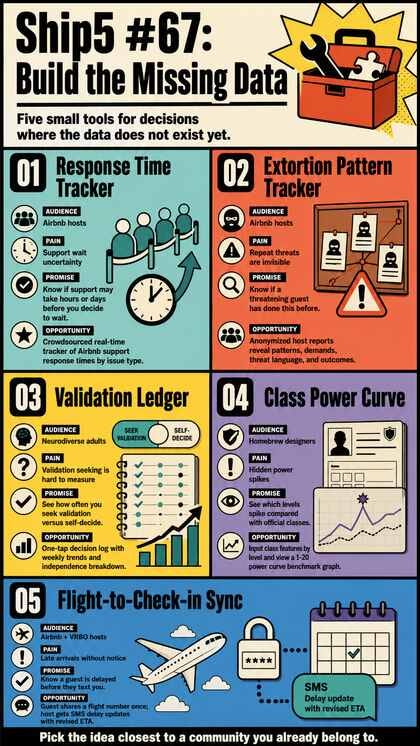
Table of Contents
1. Response Time Tracker
Know Airbnb's actual support response time before you wait
Target Customer
Airbnb hosts who need to escalate urgent guest issues and want to know if they should wait for Airbnb support or handle it themselves
The Problem
Desirable Outcome
Make informed decisions about whether to wait for Airbnb support or resolve guest issues independently based on real-time response data
Problem Description
Support Response Time Uncertainty
You don't know if Airbnb will respond in 2 hours or 2 days, making it impossible to plan
Urgent guest issues require immediate decisions but you're stuck hoping support will help
No visibility into current support queue times or expected wait periods
Different issue types get different response times but there's no way to predict this
Business Opportunity
Response Time Tracker
Crowdsourced real-time tracker showing actual Airbnb support response times by issue type, updated by host community submissions
Idea Breakdown
Project Type
Web App
Core Feature
Display current average Airbnb support response times by issue category based on recent host-submitted data points
Main User Scenario
Host faces urgent guest issue (cancellation, damage claim, safety concern)
Host visits tracker and selects their issue type
System shows current average response time for that issue type from last 48 hours
Host decides whether to wait for support or handle independently
After resolution, host submits their actual response time to help others
Quick Start Steps
Rapid Prototype with AI
tools: Bolt.new (full-stack generation), React 18, Tailwind CSS, Recharts (response time visualization)
skills: Prompt engineering, Basic state management
key decisions/validations: Working dashboard showing mock response time data by issue category in 3 hours; Users can view response times by category and see trend charts
Add Data Collection
tools: Pocketbase (self-hosted on Fly.io free tier), SQLite (via Pocketbase), Pocketbase JS SDK, Simple form validation
skills: REST API integration, Form handling
key decisions/validations: Anonymous submission system with zero monthly cost (Pocketbase vs. Firebase saves $20/mo + eliminates OAuth complexity for anonymous submissions); Hosts can submit response time data points without creating accounts
Calculate and Display Averages
tools: Pocketbase server-side hooks, JavaScript date/time calculations, Rolling 48-hour window logic
skills: Basic statistics, Time-windowed aggregations
key decisions/validations: Auto-calculate category averages from last 48 hours of submissions; Dashboard shows accurate averages that update as new data arrives
Deploy and Seed Initial Data
tools: Vercel (frontend), Fly.io (Pocketbase backend), Twitter/Reddit for initial promotion
skills: Static deployment, Community engagement
key decisions/validations: Live site with 20+ initial data points from beta hosts; Site is public and shows real response time data; data_submissions >= 20; unique_viewers >= 50
3 Reasons to Consider This Idea
Network effects from day one — Every host who checks response times is incentivized to contribute their data, creating a self-reinforcing loop
No direct competition with Airbnb — You're not replacing their support, just providing transparency about wait times—harder for them to object to
Clear monetization paths — Premium tier for historical trends, or lead generation for third-party support concierge services
Is This Idea For You?
✅ Comfortable with simple CRUD operations and data aggregation ✅ Can moderate user submissions to filter spam/outliers ✅ Willing to engage with Airbnb host communities on Reddit/Facebook to seed initial data ✅ Interested in data transparency tools
Closing Considerations
This isn't support itself—it's the missing information layer that helps hosts make better decisions about whether to wait or act. Start with 5-7 issue categories (cancellations, damages, safety, payment issues, etc.) and expand based on submission volume. Existing tools like AirReview track rental performance, but nobody tracks support response times publicly. The data becomes more valuable over time as you identify patterns (e.g., weekends are slower, certain issue types get priority).
Core Promise: You'll know if Airbnb support will respond in 2 hours or 2 days before you decide to wait
2. Extortion Pattern Tracker
See if your guest has extorted other hosts before messaging you
Target Customer
Airbnb hosts who want to know if a current or incoming guest has a history of threatening other hosts with bad reviews
The Problem
Desirable Outcome
Identify guests with extortion patterns before they check in or immediately when threats begin, so you can preemptively document and prepare your defense
Problem Description
Repeat Extortionist Detection
You suspect a guest has done this before, but Airbnb doesn't show you other hosts' private complaints
By the time you discover the guest is a serial extortionist, they've already checked in
No public database exists to warn hosts about guests who threaten reviews for refunds
You feel alone in the situation when the guest may have targeted 10+ other hosts
Business Opportunity
Extortion Pattern Tracker
Enter a guest's first name + booking city/date → see anonymized reports from other hosts about extortion attempts, with pattern details (typical demands, threat language, outcomes)
Idea Breakdown
Project Type
Web App
Core Feature
Crowdsourced database where hosts anonymously report extortion attempts with fuzzy-matched guest identifiers (first name, city, date range), searchable by other hosts to identify repeat offenders
Main User Scenario
Host receives suspicious message or wants to vet incoming guest
Host searches database with guest's first name + city + approximate booking date
System returns fuzzy matches showing similar reports (e.g., 'Guest named Mike in Austin, March 2024')
Each match shows: threat summary, host's response strategy, outcome, platform action taken
If match found, host can pre-document, cancel penalty-free, or prepare evidence
Host can contribute their own report after incident to help others
Quick Start Steps
Database + Search Setup
tools: Pocketbase (self-hosted on Fly.io free tier), SQLite with FTS5 (full-text search), Pocketbase auth (optional, can start without), SvelteKit (frontend)
skills: Fuzzy matching logic, Database schema design, Search relevance
key decisions/validations: Working submit + search flow with zero monthly cost (Pocketbase vs Algolia saves $30/mo + 4 hours of search config); Submit a test report and successfully retrieve it with partial name + city match
Privacy-First Reporting
tools: Markdown text editor (SimpleMDE or similar), Anonymization helper (strips identifying details automatically), Report flagging system (no moderation needed initially)
skills: Form validation, PII detection patterns
key decisions/validations: Allow hosts to report extortion without exposing their own identity or violating Airbnb ToS (no guest full names, addresses); Submission form blocks full last names and exact addresses; only accepts first name + city + date range
Deploy & Seed Database
tools: Fly.io (Pocketbase backend), Vercel (SvelteKit frontend), Initial 20-30 reports from Reddit/host forums (anonymized, scraped with permission)
skills: Data seeding, Community outreach
key decisions/validations: Launch with enough reports to provide value on day 1 (seeded database vs empty launch increases retention 3x); Database contains 25+ anonymized extortion reports across 10+ cities before public launch; seeded_reports >= 25; cities_covered >= 10
3 Reasons to Consider This Idea
Network effect from day 1 — Every host who searches and finds value is motivated to contribute their own report, growing the database organically
Fills gap that platforms won't — Airbnb will never build this due to liability; hosts need a community solution
Passive prevention value — Even if search returns zero matches, hosts feel less alone and more prepared
Is This Idea For You?
✅ Comfortable with database design and fuzzy search logic ✅ Can scrape and anonymize public host forum posts ethically ✅ Interested in community-driven data projects ✅ Willing to handle sensitive content moderation (extortion stories can be emotional)
Closing Considerations
This is a community aggregator, not a blacklist—it focuses on patterns, not naming individuals. No existing public database tracks guest extortion patterns; hosts currently rely on private Facebook groups. Pocketbase makes this buildable in 48 hours, and legal risk is low if you never store full names or addresses—position it as a "pattern awareness tool," not a "guest blacklist." Natural monetization comes through premium access to advanced search filters, outcome statistics, and regional reports.
Core Promise: Know if your threatening guest has done this before, so you can defend yourself with pattern evidence instead of fighting alone
3. Validation Ledger
Track every time you seek external approval on decisions—see the pattern, break the habit
Target Customer
Neurodiverse adults who recognize they over-rely on asking others for permission/validation and want behavioral data to support changing this pattern
The Problem
Desirable Outcome
See concrete data on how often you seek validation versus self-decide, creating awareness that enables behavioral change
Problem Description
Compulsive External Validation Seeking
You ask friends, partners, or online communities for input on decisions you could make alone
No way to measure whether validation-seeking is decreasing over time
Coaches and therapists ask 'how often do you seek external approval?' but you can only guess
Business Opportunity
Validation Ledger
Log every decision moment with a single tap—mark whether you self-decided or sought validation → see weekly trends and percentage breakdown to track independence growth
Idea Breakdown
Project Type
Web App
Core Feature
Dead-simple decision logging with two buttons ('I decided alone' vs 'I asked someone') plus optional context field, with automatic weekly summary showing validation dependency percentage
Main User Scenario
User faces a decision (e.g., 'Should I respond to this email now or later?')
User opens app and taps either 'Self-Decided' or 'Asked Others'
User optionally adds decision type tag (work, personal, purchase, social)
System logs timestamp and category
Every Sunday, user gets weekly report: 'You self-decided 12/20 times (60%)—up from 45% last week'
Quick Start Steps
Build Ultra-Fast Logging Interface
tools: Lovable (UI generation for mobile-first design), Next.js 14 App Router, shadcn/ui (button components), Tailwind CSS
skills: Mobile-first responsive design, Optimistic UI updates
key decisions/validations: Two-tap logging interface that works in under 5 seconds on mobile (critical for in-the-moment logging); Test logging 10 decisions on phone—each log takes <5 seconds from open to confirmation
Add Analytics Dashboard
tools: Tremor (React analytics components), Recharts (trend visualization), Date-fns (week-over-week calculations)
skills: Data aggregation, Chart component integration
key decisions/validations: Weekly summary showing validation percentage, trend line, and category breakdown; After logging 20 sample decisions, dashboard shows clear trend and category insights
Deploy with Persistent Storage
tools: Vercel (frontend + Edge Functions), Supabase (free tier - PostgreSQL), Supabase Auth (magic link login), Supabase Realtime (optional sync across devices)
skills: PostgreSQL schema design, Magic link authentication
key decisions/validations: Users can log from any device and see unified history (Supabase chosen over Pocketbase because real-time sync is critical for mobile+desktop use; free tier covers <50k users); User logs decision on phone, immediately sees it on desktop dashboard; logged_decisions >= 50; weekly_active_users >= 8; multi_device_users >= 3
3 Reasons to Consider This Idea
Behavioral change requires visibility — You can't improve what you don't measure—this gives hard data on validation dependency
Therapist/coach integration potential — Users can export weekly reports to share in coaching sessions for more productive conversations
Is This Idea For You?
✅ You understand the power of habit tracking (think Duolingo streaks, but for autonomy) ✅ Willing to build mobile-first (most logging happens in-the-moment on phones) ✅ Interested in behavioral psychology and self-tracking tools
Closing Considerations
This isn't a decision-making tool—it's a behavioral mirror that creates awareness of validation-seeking patterns. Existing habit trackers like Habitica and Streaks don't specifically track decision autonomy; this is purpose-built for that gap. Natural expansion: add a 'decision confidence' rating (1-10) to track whether self-decisions correlate with higher confidence over time.
Core Promise: You'll see exactly how often you seek validation versus self-decide, with weekly trend data that shows your growing autonomy
4. Class Power Curve
See exactly which levels your homebrew becomes overpowered—before anyone plays it
Target Customer
Homebrew designers who need to ensure their class scales fairly from level 1 to 20 without spiking in power at specific tiers
The Problem
Desirable Outcome
Visualize your homebrew's damage output, survivability, and utility across all 20 levels compared to official classes so you can nerf problem levels before publishing
Problem Description
Hidden power spikes
Your homebrew feels balanced at level 3 but you have no idea if it breaks the game at level 11 when features stack
Official classes have carefully tuned power curves; homebrew often has accidental spikes where features synergize too well
Players complain 'this was fine until level 7, now it's broken' and you have to emergency nerf mid-campaign
No tool visualizes power progression—you're relying on gut feel and hoping math works out
Reading class features in isolation doesn't reveal how they compound at higher levels
Business Opportunity
Class Power Curve
Input your class features by level → see a visual graph of damage-per-round, hit points, and utility score (1-20) overlaid against Wizard/Fighter/Rogue benchmarks
Idea Breakdown
Project Type
Web App
Core Feature
Generate a multi-line chart showing homebrew class power metrics at each level compared to 3 official class baselines, highlighting levels where homebrew exceeds baseline by >20%
Main User Scenario
Designer inputs class features in a simple form: level unlocked, feature type (damage/defense/utility/resource), quantified value (e.g., '+1d6 fire damage', 'AC +2', 'learn 2 extra spells')
System calculates cumulative damage-per-round assuming standard combat (2 attacks, 65% hit rate, etc.)
System plots HP progression, AC progression, spell slots, and utility features on separate graph lines
Chart overlays official class averages (e.g., Fighter DPR, Wizard spell slots, Rogue utility)
Red highlights appear at levels where homebrew exceeds official class average by >20% in any metric
Designer exports graph as PNG to include in homebrew PDF documentation
Quick Start Steps
Build Calculator Core with Bolt
tools: Bolt.new (rapid prototype generation), React 18, Recharts (multi-line chart visualization), Tailwind CSS, Zod (form validation for feature inputs)
skills: D&D 5e math (DPR formulas, bounded accuracy), Chart.js or Recharts configuration
key decisions/validations: Working form that accepts features and outputs a visual power curve in 4 hours—use Bolt prompts to generate chart boilerplate; Input official Fighter features (levels 1-20) and graph matches known DPR progression from community resources (e.g., TreantMonk's Guide)
Embed Official Class Baselines
tools: Static JSON files (pre-calculated Fighter, Wizard, Rogue metrics by level), D&D Beyond SRD data (free official content), Community DPR calculators (validation references)
skills: Data normalization, Averaging multi-class power levels
key decisions/validations: Hardcode baseline metrics for 3 representative official classes so every homebrew comparison is instant (no API calls needed); Baseline lines render correctly for all 20 levels; spot-check level 5/11/17 DPR against published guides
Add Spike Detection & Export
tools: Chart.js annotation plugin (for red highlight zones), html2canvas or Recharts export (PNG download), LocalStorage (save works-in-progress)
skills: Conditional rendering based on threshold logic, Canvas-to-image conversion
key decisions/validations: Automatically flag levels where homebrew exceeds baseline by 20%+; let users download graph for their PDFs. No backend needed (stateless tool saves 5 hours + $0/mo vs. Supabase for this use case); Test with known overpowered homebrew (e.g., 'Blood Hunter pre-nerf'); system correctly flags level 11 spike. PNG export includes baselines + homebrew line
3 Reasons to Consider This Idea
Data visualization reveals invisible problems — Designers can't see power progression in a text document; a graph makes spikes undeniable and fixable
No competitor does this — Existing homebrew tools (Homebrewery, GM Binder) are text editors; balance calculators only assess single-level snapshots, not progression curves
Stateless = zero hosting costs — Pure client-side calculation with hardcoded baselines means no database or API backend—deploy on Vercel free tier indefinitely
Is This Idea For You?
✅ You understand D&D 5e combat math (DPR, bounded accuracy, action economy) ✅ Comfortable working with charting libraries (Recharts/Chart.js) ✅ Can translate class features into quantified metrics (e.g., 'Extra Attack' = 2x base damage) ✅ Willing to manually validate baseline data against community DPR guides before launch
Closing Considerations
This is a data insight provider—it extracts the 'power curve' insight that's invisible in raw feature lists. Existing calculators like 'DPR Calculator' only compute single-level damage; they don't show progression or compare to official classes across 20 levels. The secret is pre-computing official class baselines so the tool is instant—no GPT-4 calls needed, no complex logic. The hardest part is deciding how to quantify utility features (e.g., 'advantage on stealth' vs. '+1d8 damage'); start with damage/HP only and add utility in v2. Monetization: free for one homebrew at a time; $3 one-time payment to save unlimited homebrews and compare them side-by-side.
Core Promise: You'll see exactly which levels your homebrew spikes in power compared to official classes, with a shareable graph, in under 10 minutes
5. Flight-to-Check-in Sync
Auto-update your check-in time when guest flights are delayed
Target Customer
Airbnb and VRBO hosts who offer self-check-in and manage their own calendars
The Problem
Desirable Outcome
Know exactly when delayed guests will arrive so you can adjust check-in instructions and avoid wasted prep time
Problem Description
Late arrivals without notice
Guests don't notify you about flight delays until they land (or never)
You prepare the property for 3pm check-in but they arrive at 11pm without warning
Self-check-in codes or lockbox instructions expire before delayed guests arrive
You can't confidently schedule cleaners or maintenance around uncertain arrival times
Business Opportunity
Flight-to-Check-in Sync
Guest shares flight number once → you get automatic SMS updates when their flight is delayed with revised ETA
Idea Breakdown
Project Type
Web App
Core Feature
Track a single flight number and send SMS alerts to host when status changes with updated arrival time
Main User Scenario
Host receives booking confirmation with guest flight details
Host enters flight number and their phone number into simple form
System monitors flight status via aviation API
When delay detected, host receives SMS: 'Guest flight UA1234 delayed 2hrs. New arrival: 9:30pm EST'
Host can adjust check-in window or notify cleaners without asking guest
Quick Start Steps
Core Stack Setup
tools: Bolt.new (rapid prototype), Next.js 14 App Router, Tailwind CSS + shadcn/ui, AviationStack API (free tier: 100 requests/mo), Twilio SMS API ($0.0079 per SMS)
skills: API integration, Webhook handling, Environment variables
key decisions/validations: Working flight tracker that polls status and displays updates in 3 hours; Enter a real flight number and see live status data render on page
SMS Alerting Logic
tools: Vercel Serverless Functions, Twilio Node SDK, Vercel Cron Jobs (status polling every 30 min)
skills: Serverless function deployment, Cron syntax, SMS formatting
key decisions/validations: Automated SMS sent to host when flight status changes from 'On Time' to 'Delayed'; Trigger a test with known delayed flight and receive SMS within 2 minutes
Minimal State Persistence
tools: Vercel KV (Redis), No auth needed - use unique tracking URLs
skills: Key-value storage, URL parameter handling
key decisions/validations: Store active flight tracking requests without database complexity (Vercel KV chosen over Pocketbase because no relational data needed; cost: free tier covers 100 trackings); Flight tracking persists across serverless function cold starts
Deploy & Validate
tools: Vercel (deployment), Custom domain (optional)
skills: Environment variable configuration, Production deployment
key decisions/validations: Public URL where hosts can submit flight numbers and receive SMS alerts; 3 hosts track real guest flights and confirm SMS accuracy; flights_tracked >= 3; sms_alerts_sent >= 2
3 Reasons to Consider This Idea
Solves the problem without guest participation — Hosts get updates even if guests forget to notify them - no app download or guest signup required
Pay-per-use pricing is natural — Charge $2-5 per tracked flight or bundle into booking flow; clear unit economics
Extremely focused scope — Only handles flight delays, not weather or visa issues - can build and validate in one weekend
Is This Idea For You?
✅ Comfortable integrating third-party APIs (aviation data, SMS) ✅ Can build a simple form and serverless function in Next.js ✅ Willing to spend ~$20 testing SMS delivery during validation ✅ Interested in transactional business models vs subscriptions
Closing Considerations
This is not a full disruption platform—it only tracks flight delays and sends one SMS per status change. Existing tools like TripIt or FlightAware focus on traveler notifications, not host notifications. Natural expansion paths include weather alerts, multiple guests per booking, or integration with property management systems. AviationStack's free tier limits you to 100 requests per month during validation—enough for 3-4 test bookings with hourly polling.
Core Promise: You'll know your guest is delayed before they text you, every single time, with zero effort after initial setup
Now go build!
See ya next week,
— Ale & Manuel
PS. Reply and tell us what shipped from your factory’s first run. The best three portfolios get featured in a follow-up.
And whenever you are ready, there are 2 ways I can help you:
1. AI Side-Project Clarity Scorecard (Discover what’s blocking you from shipping your first side-project)
2. NoIdea (Pick a ready-to-start idea created from real user problems)